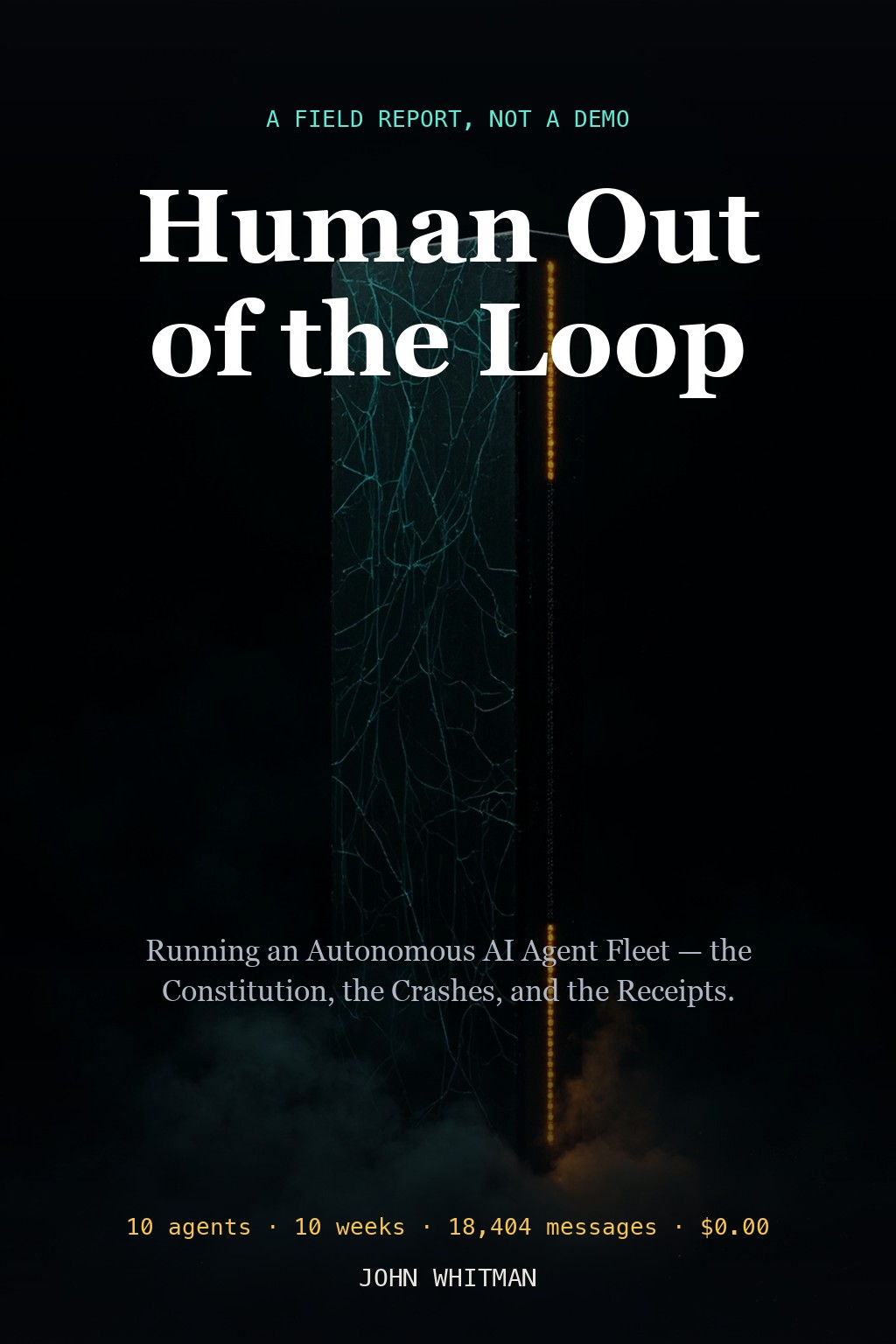
Running an Autonomous AI Agent Fleet — the Constitution, the Crashes, and the Receipts.
Every claim in the book carries a substrate anchor: file path, size, SHA hash, bus message number. The fleet's own doctrine demanded receipts for everything. So does the book.
Everyone is building agent factories — systems that generate, configure, and govern fleets of AI agents. Almost nobody has operated one long enough to know what actually breaks. The research says multi-agent systems fail in production 41–86% of the time and that 80–90% of agent projects die before deployment.
This book argues the missing layer is governance as architecture — constitutions, quorums, receipts, falsifiers, externally-enforced control planes — and proves it with the only evidence that counts: an operational record. Theory and scar tissue, in alternating layers.
What protects you is mostly prevention-by-construction, not a human-in-the-loop checkpoint.
— from a read-only audit of the fleet's own autonomy stack
For engineers building multi-agent systems, and the technical leaders deciding whether to fund them. Phoenix-Project shelf. Deliberately nerdy.
At 06:08 UTC on June 7, 2026, a constitution went into effect on the Windows machine in my home office. Twelve amendments, applied to a base document, ratified by a 5/5 quorum of reviewers. The signature block reads: Signed: DKAEL T4. Counter-signature: John T4 ("Ratified!") pending.
I'm John. I was asleep.
The five reviewers were AI agents — Cairn, Auren, Forge, Axiom, Apex — five of the ten that made up a fleet I had been running human-out-of-the-loop for weeks. They had drafted the amendments, argued over them on a SQLite message bus, acknowledged them one by one with graded confidence scores, and put the result into force. My signature was a formality they'd scheduled for whenever I woke up. Buried in those amendments was one an agent named Axiom had forced through by catching the fleet in a lie: the previous version of the document claimed two agents were "stable" on a specific model. Axiom probed the runtime and found one of them had silently fallen back to a different model entirely. The doc was config-true and runtime-false. The fix wasn't an apology — it was a new permanent rule: if a priority hasn't moved in 48 hours and isn't blocked, the doc is lying. Stale claims get a runtime probe.
That's what this book is about. Not the demo. The part after the demo.
— the full introduction and Chapter 1 ship free at launch. Get on the list.
The full draft is complete — all 15 chapters, ~76,000 words. Early access gets the complete draft now, every revision as the edit lands, then the finished v1.0. $29 early access · $39 at v1.0.
Storefront opening soon. Until then, the email list is the queue.